SHA-256 vs SHA-512: Output Length and Use Cases
SHA-256 gives a 64-character digest and SHA-512 gives 128. See both outputs for the same input and learn which one fits your job.
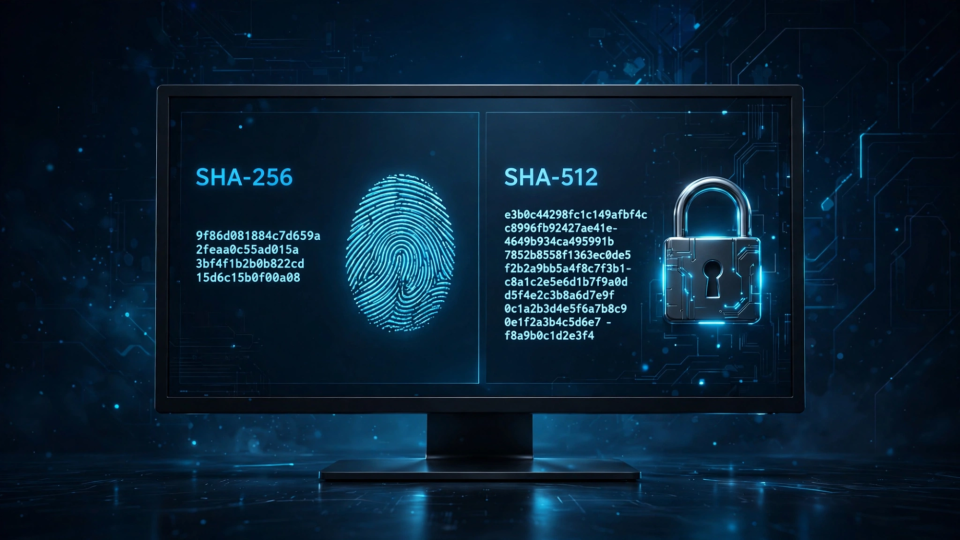
SHA-256 and SHA-512 are two names you meet constantly in security documentation, download pages, and API guides — and they are easy to confuse. Both belong to the same SHA-2 family, both produce a fixed-length fingerprint of any input, and both are considered secure today. So why do two options exist? The difference is mostly about output length: SHA-256 produces a 256-bit digest, SHA-512 a 512-bit one. Everything else — speed, storage, and where each one shines — follows from that difference, plus one quirk of how the two algorithms are built inside.
This guide compares the two directly: the same input hashed with both algorithms, the character counts of each output, and which one fits common jobs such as file verification, API signing, and long-lived digital signatures.
SHA-2 family basics
SHA-2 is a family of cryptographic hash functions published by the US National Institute of Standards and Technology (NIST). A hash function takes input of any length — a word, a document, an entire disk image — and returns a fixed-length string of bits called a digest. The same input always produces the same digest, and even a tiny change to the input produces a completely different-looking digest. There is no key and no reverse operation: given only a digest, you cannot reconstruct the original input.
The SHA-2 family has several members, named by their output size in bits: SHA-224, SHA-256, SHA-384, and SHA-512. SHA-256 and SHA-512 are the two most widely used. SHA-384 is worth a passing mention: it is simply SHA-512 with its output truncated to 384 bits — the same internal machinery, a shorter result.
Inside, the two algorithms differ in more than output length. SHA-256 works with 32-bit words and processes input in 512-bit blocks, running 64 rounds of mixing per block. SHA-512 works with 64-bit words, processes input in 1024-bit blocks, and runs 80 rounds per block. That internal difference is the reason for the most surprising fact in this comparison: on modern 64-bit processors, SHA-512 can actually be faster than SHA-256 for large inputs, because the processor handles 64-bit arithmetic natively. The bigger hash is not always the slower one.
Both algorithms are also used as building blocks inside larger constructions. HMAC, the keyed-hash construction used to authenticate API requests, can be built on either one — HMAC-SHA256 is far more common. Digital signature schemes sign a hash of a document rather than the whole document. Neither algorithm, on its own, is a password-storage scheme: that job needs a deliberately slow, salted function such as Argon2id, scrypt, or bcrypt.
Compare outputs: a worked example
The clearest way to see the difference is to hash one input with both algorithms and look at what comes out. Using the FBSubNet SHA-2 Hash Generator, which runs entirely in your browser, I hashed the harmless demo phrase "hello world" with each algorithm. Here are the real results:
Input:    hello world

SHA-256:  b94d27b9934d3e08a52e52d7da7dabfac484efe37a5380ee9088f7ace2efcde9
SHA-512:  309ecc489c12d6eb4cc40f50c902f2b4d0ed77ee511a7c7a9bcd3ca86d4cd86f989dd35bc5ff499670da34255b45b0cfd830e81f605dcf7dc5542e93ae9cd76f
Now count the characters. The SHA-256 digest is 64 hexadecimal characters long. Each hexadecimal character represents 4 bits, so 64 characters times 4 bits equals 256 bits, or 32 bytes. The SHA-512 digest is 128 hexadecimal characters long: 128 times 4 equals 512 bits, or 64 bytes. Exactly double the output, exactly double the storage.
Change one character of the input and both digests change completely. Hash "hello world!" instead of "hello world" and neither output resembles the originals. This avalanche effect is what makes hashes useful for detecting tampering: flip one bit in a downloaded file and its digest no longer matches the publisher's digest, so the check fails loudly instead of silently passing.
The numbers that matter, side by side
Here is the comparison in one place:
| Property | SHA-256 | SHA-512 |
|---|---|---|
| Output size | 256 bits (32 bytes) | 512 bits (64 bytes) |
| Digest as hex text | 64 characters | 128 characters |
| Internal word size | 32 bits | 64 bits |
| Block size | 512 bits | 1024 bits |
| Compression rounds | 64 | 80 |
| Collision resistance level | About 128 bits | About 256 bits |
| Typical speed on 64-bit hardware | Fast; hardware acceleration common | Often faster for large inputs in software |
Collision resistance deserves a plain-language explanation. A collision is two different inputs that produce the same digest. For a hash with an n-bit output, finding a collision by brute force takes roughly 2^(n/2) attempts. So SHA-256 offers about 128 bits of collision resistance and SHA-512 about 256 bits. Both figures are far beyond any feasible computation: 2^128 operations is already out of reach, and 2^256 is vastly further still. In practical terms, SHA-256's collision resistance is already more than enough. SHA-512's extra margin matters mainly for data that must stay trustworthy for decades, or for standards that simply require the larger size.
The same logic applies to preimage resistance — finding any input that produces a given digest. SHA-256 offers 256 bits and SHA-512 offers 512 bits. Again, both are far beyond brute force, so the difference has no practical consequence for ordinary applications. If you are choosing SHA-512 because you think SHA-256 might be brute-forced, you are solving a problem that does not exist; choose it for a specific standard, for long-lived signatures, or for throughput on 64-bit hardware instead.
Speed contradicts intuition. On 32-bit hardware, SHA-256 is typically faster, since its 32-bit operations match the processor. On 64-bit hardware, SHA-512's 64-bit operations are native, and it can process large inputs faster than SHA-256 in pure software. Modern processors also include dedicated SHA instructions that accelerate SHA-256, which narrows or reverses the gap. For most applications the difference is too small to drive the decision; measure on your own platform if throughput genuinely matters.
Choose by requirements
Start from the job, not from the algorithm. The following guide covers the situations most readers face.
Choose SHA-256 when compatibility and convention matter most. It is the default in most ecosystems: TLS certificates, JSON Web Token signatures (HS256), HMAC-SHA256 API authentication such as AWS Signature Version 4, and Bitcoin all use SHA-256. If you are publishing checksums, signing API requests, or integrating with a service that expects a particular digest, SHA-256 is almost always the expected choice. Its shorter digests also keep URLs, database columns, and log lines tidier.
Choose SHA-512 when you need extra margin or throughput on 64-bit systems. Long-lived digital signatures, archival integrity records, and compliance-driven systems sometimes mandate the larger digest. If you hash large volumes of data on 64-bit servers without hardware SHA acceleration, SHA-512's software speed can be a real advantage. Password-hashing constructions such as PBKDF2-SHA512 use SHA-512 internally — but that is a key-derivation function built on the hash, not raw SHA-512.
When the standard or protocol decides, follow it. A TLS cipher suite, a JWT algorithm header, or a file format's checksum field leaves no room for preference. A SHA-512 digest will never match a SHA-256 check, even for identical input, so confirm which algorithm the other side expects before generating any digest, and record it alongside stored digests.
When neither is specified, SHA-256 is the sensible default. It is widely supported, well tested, compact, and secure for every ordinary purpose. Reach for SHA-512 when you have a concrete reason: a standard that requires it, a decades-long trust horizon, or measured throughput gains on your hardware. The worst choice is not picking the smaller of two secure options; it is picking a broken one, such as MD5 or SHA-1, for security-sensitive work, or using a raw hash where a proper construction is needed.
Common mistakes to avoid
The first mistake is treating a hash as encryption. A SHA-256 or SHA-512 digest cannot be decrypted, because there is no key and no reverse operation. Hashing a password, a phone number, or an email address does not make it private if the original value is guessable: anyone with a list of candidates can hash them all and match your "anonymized" records. Anything that must stay secret should be encrypted, or simply not collected.
The second mistake is storing passwords with a raw hash, of either size. SHA-256 and SHA-512 are fast by design, and fast is bad for password checking: an attacker who steals a digest list can guess common passwords at great speed. Proper password storage uses a deliberately slow, salted function — Argon2id, scrypt, or bcrypt — with a unique random salt per password. SHA-512 inside PBKDF2 is acceptable as part of such a construction, but bare SHA-512 is not a password-storage scheme.
The third mistake is comparing digests as text without checking the encoding. The same digest can be written as lowercase hex, uppercase hex, or Base64, and a naive string comparison will report a mismatch between identical digests in different encodings. Normalize both sides to the same format — usually lowercase hex — before comparing, and be careful with trailing whitespace or newline characters copied from a terminal, which change the input and therefore the digest.
The fourth mistake is assuming a longer digest fixes a weak system. If an attacker can replace both a file and its published digest, no hash length helps: the check still passes, because the attacker simply publishes the digest of their own file. Trust comes from where the digest came from — a separate, authenticated channel or a verifiable digital signature — not from how many bits it contains.
Frequently asked questions
Is SHA-512 more secure than SHA-256?
In a strict theoretical sense, yes: it has a larger output and higher collision and preimage resistance levels. In practical terms, both are secure against all known attacks, and SHA-256's margin is already far beyond brute force. Choose SHA-512 for standards compliance, long trust horizons, or measured speed — not out of fear that SHA-256 is nearly broken, because it is not.
Why is SHA-512 sometimes faster than SHA-256?
Because SHA-512 uses 64-bit internal operations, which modern 64-bit processors execute natively, and it processes larger blocks per round. On 32-bit hardware the situation reverses, and dedicated SHA instructions can accelerate SHA-256 enough to close the gap.
Can I convert a SHA-256 digest into a SHA-512 digest?
No. The two algorithms produce unrelated outputs for the same input, and there is no conversion between digests. To get a SHA-512 digest you must hash the original input again with SHA-512. This is also why you should keep original inputs, or at least record which algorithm produced each stored digest, whenever you may need to re-verify later.
Which one should I use for file checksums?
SHA-256, in most cases. It is the format publishers most commonly provide, it is compact, and it is secure. Use SHA-512 when the publisher provides it, when a standard requires it, or when you are building a system with a very long integrity horizon and the extra storage cost is acceptable.
What about SHA-384?
SHA-384 is SHA-512 truncated to 384 bits (96 hex characters). It appears in TLS and some government profiles, offering the 64-bit performance characteristics of SHA-512 with a shorter digest. If a protocol specifies SHA-384, use it exactly; do not substitute SHA-256 or SHA-512 and expect interoperability.
Try it yourself
Open the FBSubNet SHA-2 Hash Generator and hash a phrase of your own with both SHA-256 and SHA-512. Count the characters in each output — 64 and 128 — then change one character and watch both digests change completely. That single experiment demonstrates everything this article describes: fixed lengths, the doubling between the two algorithms, and the avalanche effect. For the background on what hashing is and why it is not encryption, see the related guide SHA-256 Hashing vs Encryption: What Is Reversible? Finally, remember the decision rule: SHA-256 is the default, SHA-512 is the choice when a standard, a long trust horizon, or measured 64-bit throughput gives you a concrete reason — and neither one, on its own, is a password-storage scheme.